
20 January 2026: We hope your year 2026 is off to a good start. We proudly share our 2025 Newsletter:
CHS Newsletter 2024
We are happy to share our 2024 Newsletter, along with our warmest wishes for the holidays: https://21in21.co.uk/wp-content/uploads/2024/12/chs-newsletter-2024-3.pdf

Centre for Hellenic Studies Newsletter 2023
We are delighted to share the CHS’ annual newsletter for 2023. Please click on the image below to read.

Rumble Trip 2023
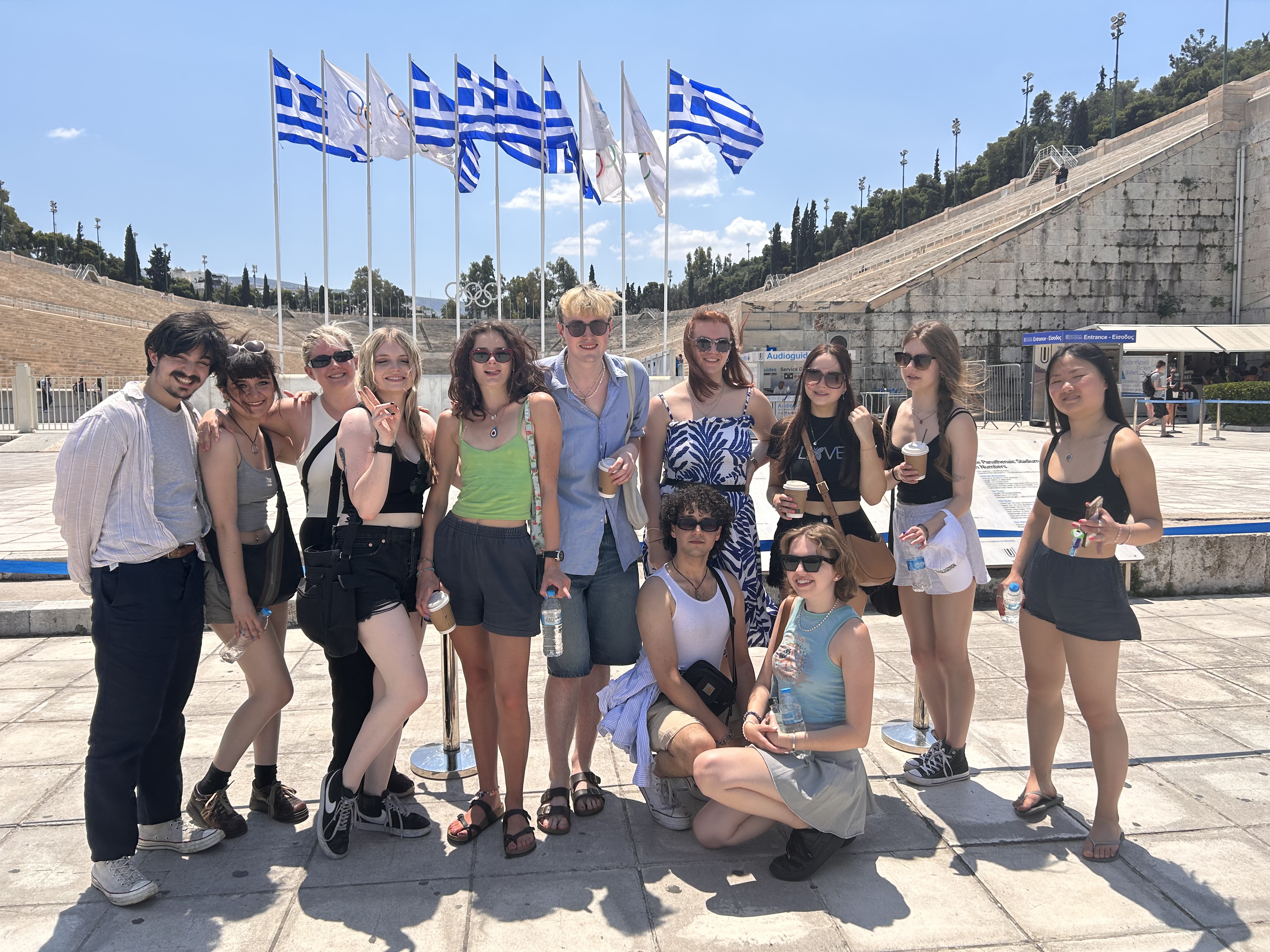
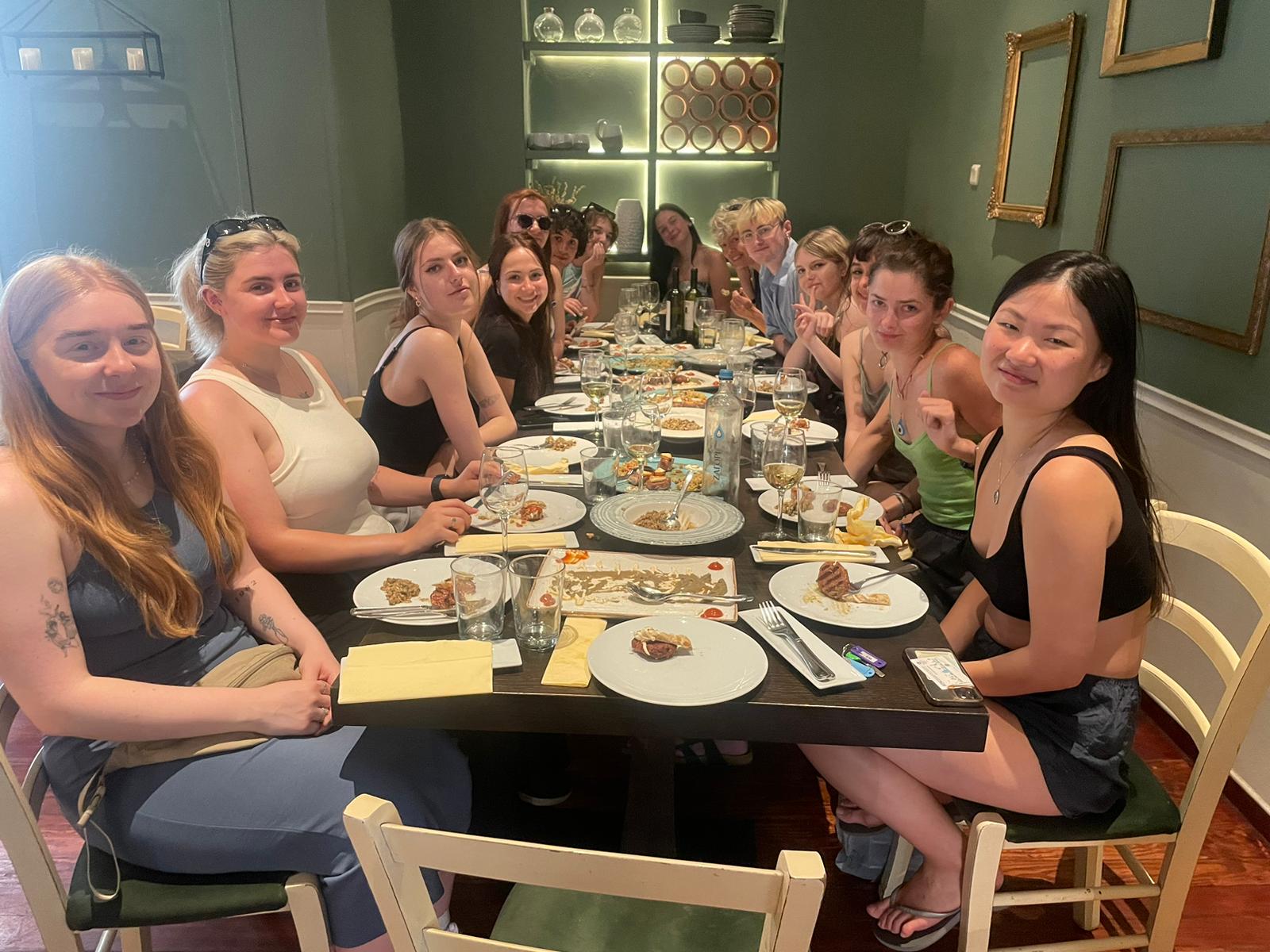
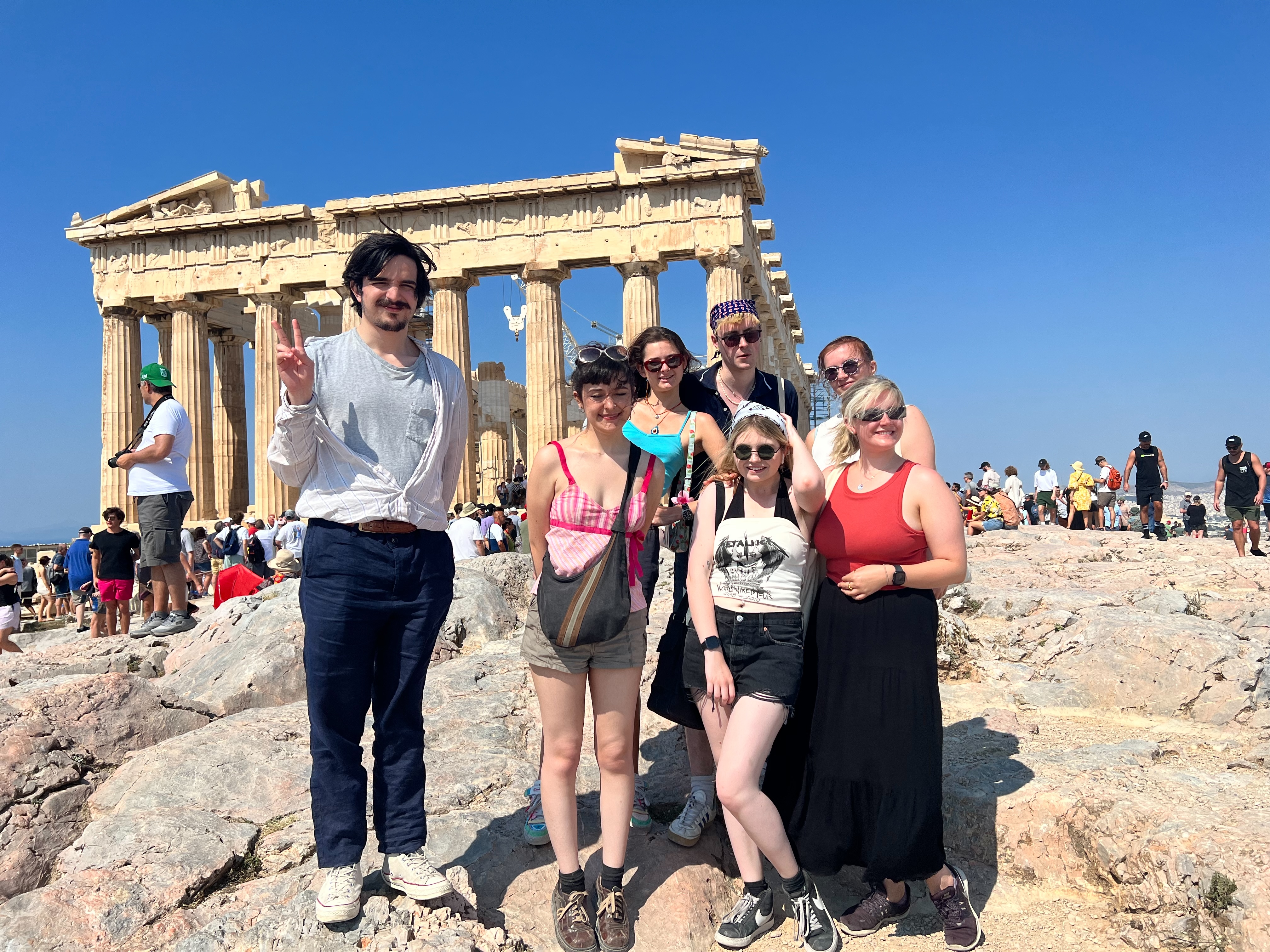
A recent fully funded five-day visit to Greece for fourteen students of the Classics Department was made possible by the generosity of the Jamie Rumble Memorial Fund. The student trip took place in late June 2023, and focused on the highlights of Athens, ancient through modern. Koraes Professor Gonda Van Steen led the fieldtrip, which was part of her undergraduate module ‘Adventures in Ancient Greek Drama’. The fourteen participants visited museums and sites, with a focus on classical drama and art and architecture. In addition to the must-see sites of Athens (Theatre of Dionysus, Acropolis, ancient art museum), the students also visited the spectacular Basil and Elise Goulandris Foundation Museum, where they enjoyed a guided tour of major works of art in the collection. Also, they found themselves shopping for fresh fruits and vegetables at the colourful Friday farmers’ market in Pangrati and enjoyed interacting with the local coffee shop owners. The students liked staying in the modern student apartments provided by The Athens Centre, which added to their living experience of a residential neighbourhood in downtown Athens. Some apartments offered spectacular views of the mountains and the sea, and they became evening gathering hubs. Several students managed to fit in late afternoon beach visits as well, since the weather was perfect for swimming and sunbathing. Everyone returned safely and satisfied. We are grateful to the generous sponsor for making the 2023 Rumble trip possible.
More information about the Rumble trip can be found here. For further information about the Rumble Fund in King’s Department of Classics and the activities it supports in the fields of Art and Archaeology, please contact Professor Van Steen and Dr Will Wootton.
Roderick Beaton Sworn in as Greek Citizen
Prominent professor and Hellenist Roderick Beaton took the oath to become a Greek citizen at a ceremony held at the Bank of Greece on Tuesday.
Beaton, who joined the faculty at King’s College London in 1981, became Koraes Professor of Modern Greek and Byzantine History, Language and Literature in 1988. He retired from the college in 2018 after also having served as head of the college’s Department of Byzantine and Modern Greek Studies and director of the Centre for Hellenic Studies.
He is a fellow of the British Academy and of King’s College, and was recognized by the Greek state with the Commander of the Order of Honor of the Hellenic Republic (2019). He is a fluent speaker and writer of Greek and has often been interviewed and commented in Greek media. He also has numerous publications, including “The Greeks: A Global History,” which has been recently published in Greek translation.
The request for honorary citizenship had been submitted to the government by Bank of Greece Governor Yannis Stournaras.
“Professor Beaton firmly believes that the long history of Greece does not relate to Greeks alone, but to the entire world as well,” said Stournaras, noting that Beaton claims that Greek is one of three languages globally that show a continuity in written form for over 3,000 years – the others being the Chinese and Hebrew.
Beaton is already a Greek, “and this honorary citizenship is simply the official recognition of a lifetime’s relationship with Greek letters and the Greek culture,” Stournaras said.
Interview: Dr Vally Lytra
Dr Vally Lytra is Reader in Languages in Education in the Department of Educational Studies at Goldsmiths, University of London. She is an alumna of King’s Department of Byzantine and Modern Greek Studies. This interview features the 2022 collective volume, Liberating Language Education, published by Multilingual Matters.

The Katie Lentakis Memorial Fund Award 2022
The annual Katie Lentakis Memorial Fund Award was established by the Anglo-Hellenic League in memory of the late Mrs Katie Lentakis, and was first awarded in 2002. Katie Lentakis (1920-2000) was a devoted member of the Anglo-Greek community of London for many years and Vice-Chair of the Anglo-Hellenic League, who loved music and art – and had helped British soldiers to escape in Greece during World War II.
The Award is made to a final-year undergraduate studying in the Faculty of Arts & Humanities at King’s College London who submits an essay of 7,000-10,000 words on a topic related to any field of Hellenic Studies. The deadline is 6 May 2022. Participants are requested to send a full pdf copy of their essay to classics@kcl.ac.uk and cc gonda.van_steen@kcl.ac.uk.
A committee of experts established by the Director of the Centre for Hellenic Studies and the Chair of the Anglo-Hellenic League will choose the recipient of the Award.
The Award, which may be divided between more than one winner, will be of the value of £500.
The result will announced and the award presented by the Chair of the Anglo-Hellenic League, Dr. John Kittmer, on Monday, 27 June 2022, in the Council Room of the King’s building, at 18.00. For further information: classics@kcl.ac.uk

Announcement: Niki Marangou Translation Prize 2022
Call for Submissions: The 2022 Niki Marangou Translation Prize

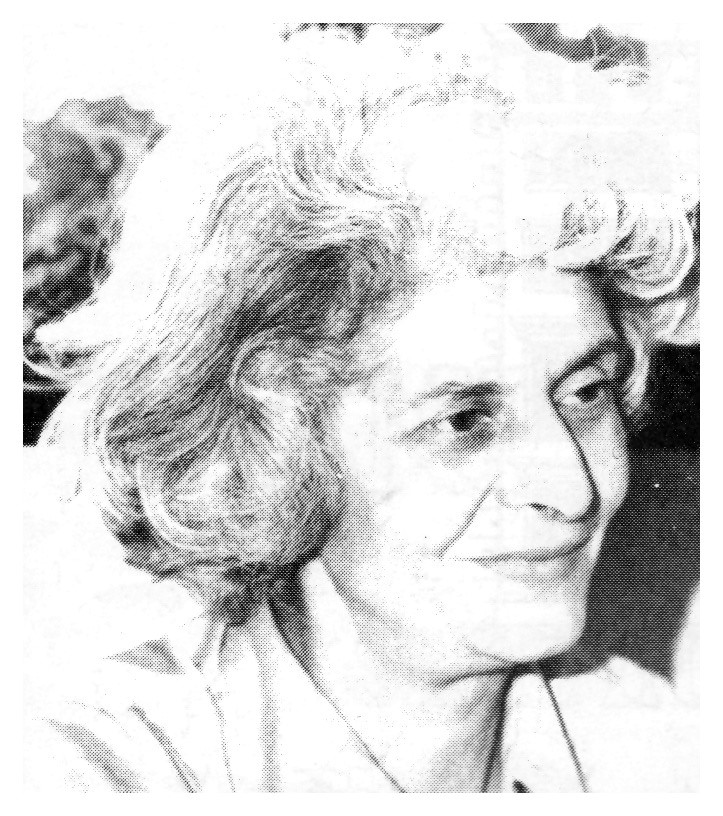
The Niki Marangou Prize was first established in 2016 to honour the memory of the inspirational Cypriot poet, novelist and painter Niki Marangou, who died in 2013. From 2019 onwards, the prize has been awarded annually for a literary translation from Modern Greek into English of one poem and one prose extract from the work of Niki Marangou.
The value of the Niki Marangou Translation Prize is £500. Participants select two full pages from any of the published works by Niki Marangou to translate, whether from her poetry collections or from her prose works. Participants also add a cover letter in which they place the chosen work in context (1 page). Entries must be submitted electronically, as a single pdf scan (original Greek text + translation + 1p. cover letter), by the deadline of 16:00 on 9 September 2022, by emailing them to gonda.van_steen@kcl.ac.uk (Prof. Gonda Van Steen) and to ag585@cam.ac.uk (Dr Liana Giannakopoulou). The competition is open to all BA, MA or PhD students currently enrolled in any England-based university. All entries will be judged by a panel of three members of the teaching staff in Modern Greek Studies. The panel will normally include and be chaired by the Koraes Professor at King’s College London. Winning entries may be published on the Niki Marangou website.
The award will be announced on 28 October 2022, at the fourth Niki Marangou Annual Memorial Lecture, co-organised with King’s Centre for Hellenic Studies. This fourth Niki Marangou Lecture will be held in London, and the featured speaker will be the former diplomat and King’s alumna, Dr Catherine Boura.
Niki Marangou (1948-2013) was born in Limassol, Cyprus, but part of her family hailed from Famagusta. She was an acclaimed writer and painter. She studied sociology in West Berlin from 1965 to 1970. After graduating, she worked as a dramaturge at the State Theatre of Cyprus. Marangou published books of prose, poetry, and children’s fairy tales, and she held seven exhibitions of her work in painting. She won numerous prizes, including the 1998 C.P. Cavafy Prize for Poetry and the 2006 Athens Academy Poetry Award for her collection Divan. She was a member of the Hellenic Authors Society and the Cyprus Writers Association. From 1980 to 2007, she was the director of the Kochlias Bookshop in Nicosia. Marangou died in a car accident in Egypt in 2013.
Previous Niki Marangou Prize Winners were:
2021 Elpiniki Meimaroglou
2020 Nicholas Kabanas
2019 Petros Nicolaou
2018 Eleonora Colli
Previous winner of the Niki Marangou Undergraduate Prize were:
2017 Felicity Beech
2016 Konstantinos Lygouris
For more information in context, see the CHS website (tabs ‘Awards’ and ‘Activity’). See also our Events page.
Rumble Fund Lecture Examines Greek Portrayal in 50s and 60s Pop-culture
The 2022 Rumble Fund Lecture in Classical Art was delivered by Professor Dimitris Plantzos from the National and Kapodistrian University of Athens, with the title Acropolis Adieu: Popular Images of Greece in the 1950s and ’60s. The Centre for Hellenic Studies at King’s and Department of Classics is delighted to share a recording of the lecture here.
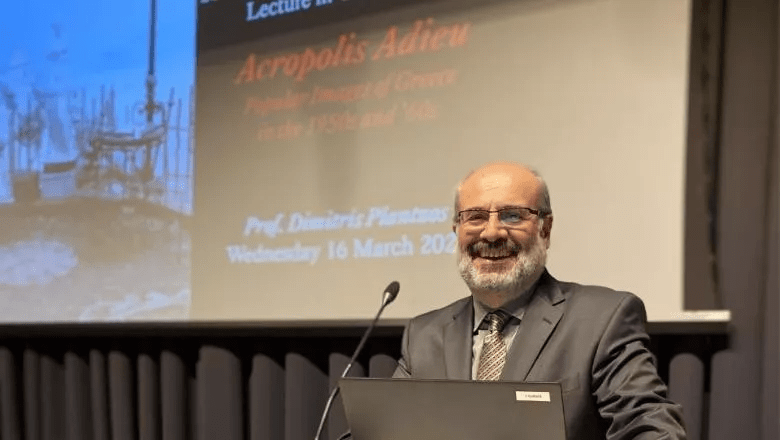
The Rumble Lectures have been held every year since 2014, and Professor Plantzos’ lecture – a collaboration between the Centre for Hellenic Studies and Department of Classics and the Courtauld Institute and Institute of Classical Studies – was delivered to a large audience in Great Hall at King’s on 16 March 2022.
Plantzos’ lecture revisited a selection of international pop-culture products from the 1950s and the 1960s (including songs, movies and novels), in order to examine ways in which Greece and ‘Greekness’ were imagined and portrayed. Broadcasting images of an exoticised – and quite often Orientalised – Greece, the international pop-culture industry was able to create a convenient narrative of ‘merry backwardness’ for the country and its people. Greece is constructed in these products as a world apart – somewhat eccentric but also underdeveloped; a place to visit yet certainly also a place to leave behind; a landscape of ancient glories and modern distractions from modernity itself; a land defined by its own separateness. Yet these imageries were often adopted with marked enthusiasm by the Greek composers, lyricists and film directors themselves, who ended up creating the thoroughly imagined Greece we still inhabit today.
Dimitris Plantzos is Professor of Classical Archaeology at the National and Kapodistrian University of Athens. He studied history and archaeology at Athens, and holds an MPhil and a DPhil in classical archaeology from Oxford, where he also spent three years as a British Academy Postdoctoral Fellow. He is the author of various papers and books on Greek art and archaeology, archaeological theory and classical reception. His Greek-language textbook on Greek Art and Archaeology, first published in 2011 by Kapon Editions, was published in 2016 in English and is now available by American publishers Lockwood Press in Atlanta, Georgia. His most recent book is The Art of Painting in Ancient Greece, published by Kapon Editions and Lockwood Press in 2018.
More information about the Rumble Fund in the Department of Classics at King’s College London can be found here.
Mariupol and King’s College London
By Professor Charlotte Roueché, Professor Emerita, CHS
Greek communities have flourished on the northern shore of the Black Sea for more than two millennia. King’s academics have been actively involved in studying and publishing the history of the ancient and medieval settlements: see the Ancient Inscriptions of the Northern Black Sea project.
In the later 18th century, Catherine the Great invited Greeks from the Crimea to help bring civic life to the newly conquered territories to the north of the Sea of Azov; their main centre was the new city of Μαριόπολις, City of the Virgin Mary, Mariupol, founded in 1778. During the 19th century the region became increasingly industrialised, not least thanks to the initiatives of a Welsh mine owner, John Hughes, who founded the settlement which is now Donetsk. Mariupol grew as the principal port for the industry; it is also the site of important steel works which have been the main source of the city’s prosperity. But they are old Soviet installations, and Mariupol claims the worst pollution in Ukraine. The city is on the Sea of Azov, which is shallow and very polluted. City and industry have been trying to work out how to improve the environment without wrecking the economy.
The whole region saw immigration from many countries and ethnic groups. The Mariupol Greeks, the oldest group, retained their sense of identity, and also, with some difficulty, their language. This goal was given new support in 1991 by the foundation of Mariupol State University (MSU). The Faculty of Greek Philology, specializing in modern Greek language and literature, is one of relatively few departments of Modern Greek outside Greece and Cyprus, of which King’s is one of the oldest. The development of the Faculty was encouraged by the A. G. Leventis Foundation, which donated the important Dino Leventis Library of Greek literature. The University was also responding to the needs of the local community in building expertise in environmental studies. In 2006 the Leventis Foundation funded an international conference at the University on environmental regulation, and in 2008 they made a gift to the university to support environmental education. Among other resources, they donated video-conferencing equipment in order to foster international relationships.
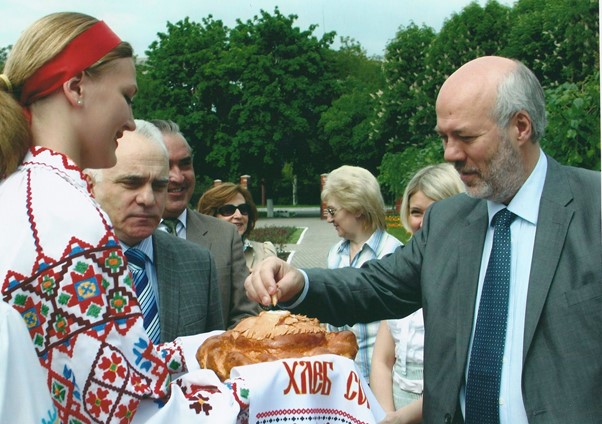
In 2011 MSU held a conference to celebrate their 20th anniversary. With the support of the Leventis Foundation, King’s College London was represented by Professor Keith Hoggart, Vice Principal for International Relations, and Professor Charlotte Roueché, Director of the Centre for Hellenic Studies. They were received with great generosity and enthusiasm for collaboration, both from the University and also from the mayor. They signed an initial agreement to collaborate further. On returning to the UK, they started to prepare proposals to collaborate in Modern Greek Studies and also in environmental pollution studies — strong areas at King’s.
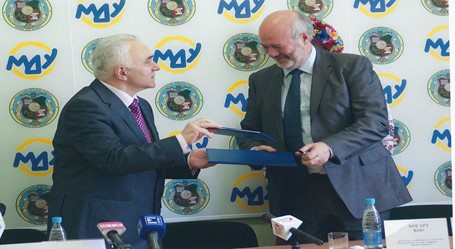
Further progress was stalled by financial problems in the UK, and by the increasingly difficult political situation in Ukraine. Hoggart and Roueché both retired, and the potential collaboration lay dormant. In 2011 Mariupol was not a name recognised throughout the world. It is to be hoped that, when the city and community come to be rebuilt, King’s can find ways to contribute to the academic and intellectual restoration of Mariupol and its University.
 21in21.co.uk